Sleep Is When It All Clicks
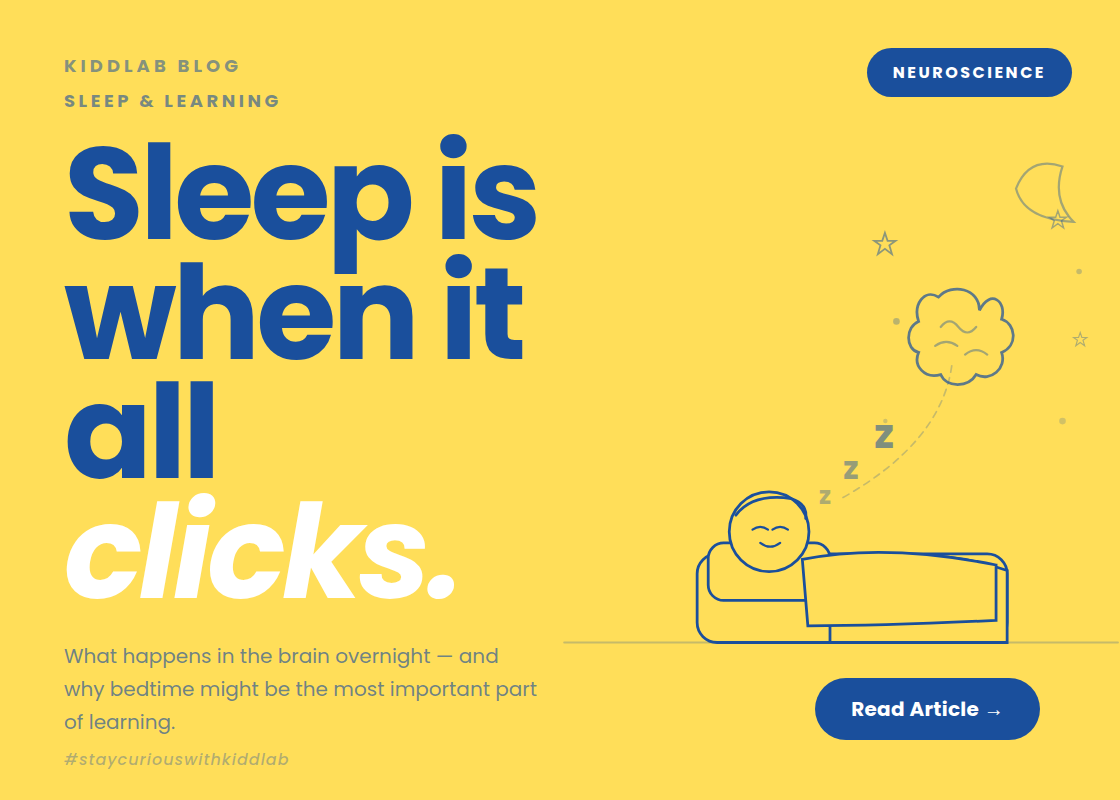
Here is the version of learning most of us grew up with: sit down, pay attention, practise, repeat. Sleep is just the pause in between — necessary, sure, but essentially passive. You close your eyes, the day stops, and tomorrow you pick up where you left off.
That story isn't wrong exactly. It's just missing the most interesting part.
A 2023 review published in Emerging Topics in Life Sciences — pulling together 19 systematic reviews and meta-analyses, screening over 1,400 studies — makes a compelling case that sleep is not a pause in learning at all. It is, in many ways, the most productive part of it (Weighall & Kellar, 2023).
Your brain rewrites its notes while you sleep
When you learn something new, it doesn't arrive fully formed. It sits in the hippocampus — fragile, loosely encoded, easy to lose. What happens overnight is something closer to editing than filing: the brain replays the day's experiences, pulls out what matters, and begins moving it into long-term storage in the neocortex, where it gets woven into everything you already know.
This is why something you struggled to understand on Tuesday evening can feel clearer by Wednesday morning — not because you thought about it more, but because you slept. The consolidation happened without you.
Children's sleeping minds are in overdrive
One of the more surprising findings in Weighall and Kellar's (2023) review: children benefit more from sleep for certain types of learning than adults do. Specifically, when it comes to integrating new words and concepts into existing knowledge, the overnight boost is larger in children than in adults. The developing brain doesn't just need sleep — it uses it with unusual intensity.
For parents and educators, this is worth sitting with. The hour before bed isn't wasted time. A story, a new word, a curious question left unanswered — these don't disappear when a child falls asleep. They get processed.
Naps are not laziness. They're infrastructure.
The review also looks at daytime naps, particularly in young children, and the findings are consistent: even short naps facilitate the same kind of memory consolidation that happens overnight, just compressed. For a four-year-old, the midday rest isn't a break from learning. It is learning, continuing.
This doesn't mean you can skip the waking hours — attention, curiosity, and genuine engagement still matter enormously during the day. But Weighall and Kellar's (2023) synthesis makes a persuasive case that we've been underestimating the nocturnal side of the equation. Rich learning experiences are worth protecting in the hours before sleep. Sleep itself is worth protecting, period.
The click you feel when something finally makes sense? It might have happened at 2am, quietly, while you were somewhere else entirely.
References
Weighall, A., & Kellar, I. (2023). Sleep and memory consolidation in healthy, neurotypical children, and adults: A summary of systematic reviews and meta-analyses. Emerging Topics in Life Sciences, 7(5), 513–524. https://doi.org/10.1042/ETLS20230110 — https://pubmed.ncbi.nlm.nih.gov/39288097/
Diekelmann, S., & Born, J. (2010). The memory function of sleep. Nature Reviews Neuroscience, 11(2), 114–126. https://doi.org/10.1038/nrn2762 — https://pubmed.ncbi.nlm.nih.gov/20010999/