The Science of Failing Well
We spend a lot of time trying to help learners avoid mistakes. We scaffold, we guide, we correct before the error even fully forms. The instinct makes sense — discomfort is uncomfortable, and watching someone struggle feels like watching someone suffer. But a growing body of neuroscientific and educational research suggests that this instinct, however well-intentioned, may be working against the very outcome we want.
Failure, it turns out, is not the opposite of learning. In many cases, it is the mechanism.
What Happens in the Brain When We Get Something Wrong
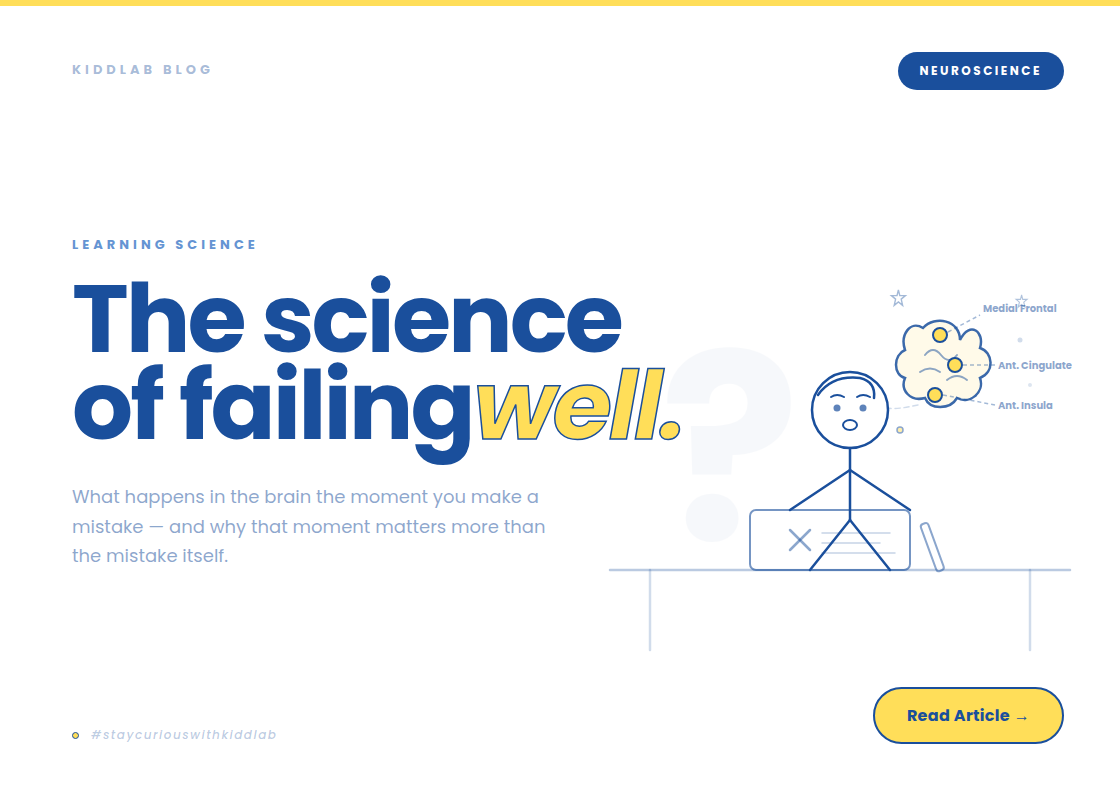
The moment a mistake occurs, the brain does not shut down or stall. It mobilizes. Neuroimaging research has consistently shown that error commission simultaneously activates a network of at least three distinct brain regions: the medial superior frontal cortex, the dorsal anterior cingulate cortex, and the bilateral anterior insula (Neta et al., 2015). This is not a passive response. Each region plays an active role — flagging the mismatch between expectation and outcome, redirecting attention, and signaling to the rest of the brain that something important just happened and needs to be encoded more carefully.
Researchers at Caltech and Cedars-Sinai identified specific neurons in the medial frontal cortex — called error neurons — that fire immediately after a person makes a mistake, before any external feedback is given (Fu et al., 2019). This means the brain begins its error-correction process autonomously, within fractions of a second. The signal is fast, specific, and purposeful.
This neural cascade is accompanied by a measurable brainwave signature known as the error-related negativity, or ERN — a spike of electrical activity over the medial frontal cortex that has been documented across decades of electroencephalographic research (Gehring et al., 1993). The ERN is not merely a marker of distress. It is a marker of engagement. The larger the ERN, the more attentional resources the brain allocates to processing what went wrong — and to making sure the correct information sticks.
Why Struggle Produces Better Learning Than Smooth Success
Beyond error detection, research on instructional design has examined what happens when learners are allowed — or required — to struggle before receiving guidance. Kapur (2016) introduced the concept of productive failure, demonstrating in a series of controlled studies that students who attempted to solve complex problems before receiving formal instruction significantly outperformed peers who received direct instruction first, even when the initial attempts were largely incorrect. The errors themselves generated a kind of cognitive preparation: learners arrived at the instruction phase with activated prior knowledge, a clearer sense of the problem structure, and a deeper motivation to understand the solution.
This finding has been replicated across age groups and subject areas. The implication is not that instruction should be withheld, but that placing struggle before instruction — rather than eliminating it — produces meaningfully better outcomes.
Metcalfe (2017) extended this understanding through a review of error-based learning mechanisms, noting that near-miss errors — cases where a learner produces a plausible but incorrect answer — lead to particularly strong retention of the correct information once provided. The effort of generating a wrong answer, it seems, is not wasted. It primes the brain to receive and hold the right one.
What This Means in Practice
For educators and parents, the research points in a clear direction: the goal should not be to eliminate failure, but to create conditions in which failure is safe, supported, and followed by good feedback.
This does not mean making learning arbitrarily difficult, or withholding help when a learner is genuinely lost. It means resisting the reflex to intervene the moment struggle appears. It means treating a wrong answer as the beginning of a conversation rather than the end of one. It means understanding that the discomfort of not knowing, and the effort of trying anyway, is doing something neurologically real.
The brain learns best when it has something to correct. Every error is, in this sense, an invitation — a moment when three distinct regions of the brain are simultaneously lit up and listening. What happens next matters enormously.
Protect the struggle. Let the error do its work.
References
Fu, Z., Rutishauser, U., Mamelak, A. N., Ross, I. B., Chung, J. M., & Adolphs, R. (2019). Single-neuron correlates of error monitoring and post-error adjustments in human medial frontal cortex. Nature Communications, 10, 3992. https://doi.org/10.1038/s41467-019-11893-w
Gehring, W. J., Goss, B., Coles, M. G. H., Meyer, D. E., & Donchin, E. (1993). A neural system for error detection and compensation. Psychological Science, 4(6), 385–390. https://doi.org/10.1111/j.1467-9280.1993.tb00586.x
Kapur, M. (2016). Examining productive failure, productive success, desirable difficulties, and impactful learning. Educational Psychologist, 51(2), 289–299. https://doi.org/10.1080/00461520.2016.1155457
Metcalfe, J. (2017). Learning from errors. Annual Review of Psychology, 68, 465–489. https://doi.org/10.1146/annurev-psych-010416-044022
Neta, M., Schlaggar, B. L., & Petersen, S. E. (2015). Separable responses to error, ambiguity, and reaction time in cingulo-opercular task control regions. NeuroImage, 107, 49–56. https://doi.org/10.1016/j.neuroimage.2014.11.041