Aging Doesn't Slow Your Brain. It Changes Its Strategy.
By KiddLab | #staycuriouswithkiddlab
There is a story most of us have quietly accepted about getting older and learning. That somewhere in our thirties, or forties, or fifties, a door begins to close. That the ease with which we once absorbed new languages, new skills, new ideas was a gift of youth — and youth alone. That the brain, like muscle, peaks and then declines. It's a compelling story. And it is mostly wrong.
The Part That Is True
To be fair to the worry: some things do change. Processing speed — how quickly the brain handles novel information — does slow with age. Working memory, the mental scratchpad we use to hold and manipulate information in real time, becomes less reliable. The ability to rapidly switch between tasks, to screen out irrelevant stimuli, to learn something entirely new in a single pass — these show measurable decline starting in early adulthood.
A landmark 2022 study published in Science Advances followed thousands of adults across their lifespans and confirmed this pattern clearly. Tucker-Drob et al. found that fluid abilities — the cognitive capacities that require effortful, in-the-moment reasoning — show consistent decline with age. The data was not ambiguous. The decline is real (Tucker-Drob et al., 2022).
But here is what the same study also found, buried in the same dataset, and far less discussed: crystallized abilities — the kind rooted in accumulated knowledge, pattern recognition, and applied understanding — showed no such decline. In fact, for many people, they continued to improve well into the sixth and seventh decades of life.
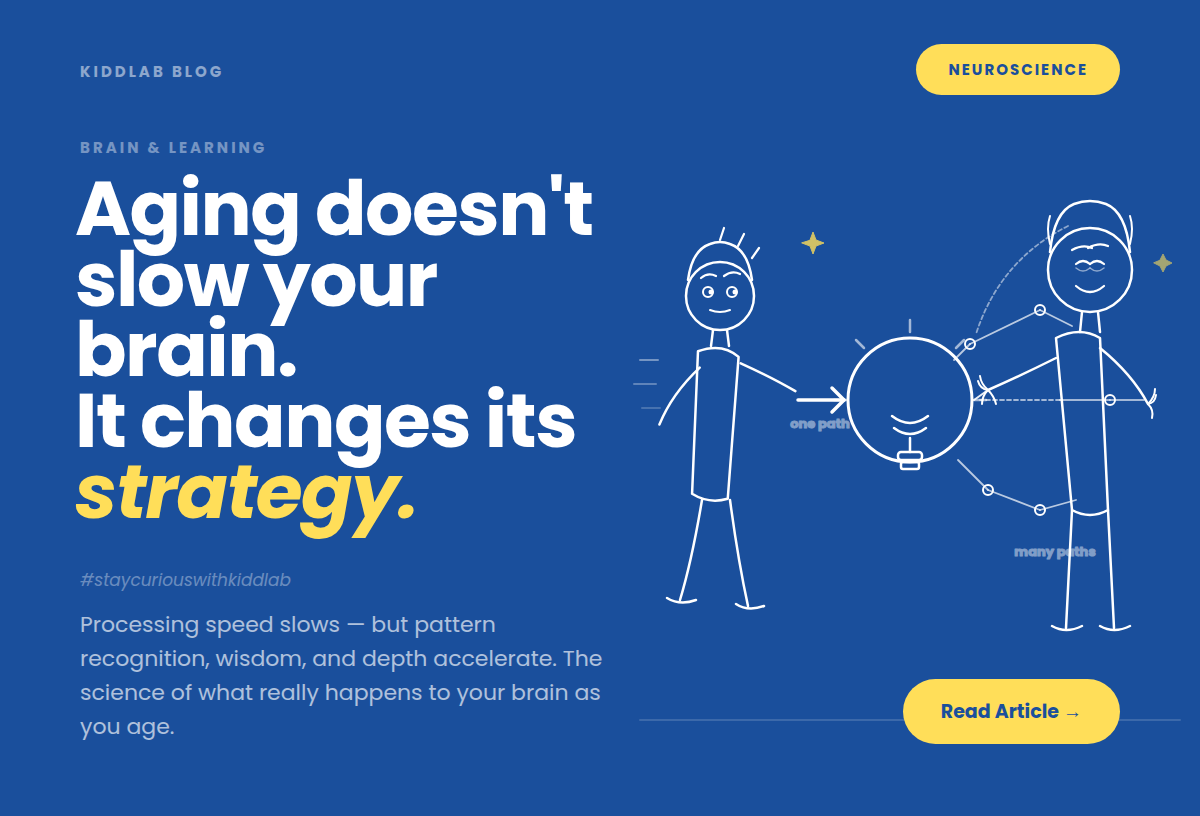
The brain was not weakening. It was reorganizing.
Two Kinds of Intelligence
The distinction between fluid and crystallized intelligence has been around since the 1960s, but it has never been communicated well to the public. We tend to treat intelligence as a single thing — you have more or less of it, and aging takes some of it away. But the research tells a more interesting story.
Fluid intelligence is speed. It is the ability to solve a problem you have never seen before, with no context to lean on. It peaks in the mid-twenties and declines from there. This is the cognitive profile of a chess prodigy, a mathematics student, a competitive programmer.
Crystallized intelligence is depth. It is the ability to draw on decades of experience, to see the structure beneath a problem, to recognize what a situation means rather than just what it contains. Vocabulary grows. Judgment sharpens. The capacity to read people, institutions, and complex systems improves. This is the cognitive profile of a seasoned therapist, a skilled negotiator, an experienced physician.
The older brain is not losing intelligence. It is shifting from one form of intelligence to another — and in many domains of real life, the one it is shifting toward is more valuable.
The Brain Compensates — And Then Some
What makes this especially interesting is that the aging brain does not passively accept the changes in its processing speed. It actively adapts. Neuroimaging research has shown that older adults frequently recruit more brain regions to complete tasks that younger adults handle with fewer. Where a 25-year-old might solve a complex problem using a single hemisphere, a 65-year-old will often engage both — drawing on broader networks of association, experience, and meaning.
This phenomenon, sometimes called bilateral recruitment, was long interpreted as a sign of deterioration — the brain struggling to compensate for damage. More recent thinking reframes it entirely: the aging brain is not limping along with extra resources. It is applying richer, more distributed processing to problems that benefit from exactly that.
A 2024 review in Frontiers in Aging Neuroscience by Navakkode and Kennedy examined the cellular and synaptic mechanisms underlying this kind of neural adaptation. Their work confirms that while certain forms of synaptic plasticity — particularly those dependent on speed — do diminish with age, the brain retains meaningful capacity for reorganization and learning throughout the lifespan. The aging brain, they conclude, is not a failing brain. It is one navigating a different set of constraints with a different set of tools (Navakkode & Kennedy, 2024).
What This Means for How We Learn
The implications for learning are significant — and almost universally ignored in how we design educational experiences for adults.
Most adult learning environments — corporate training, online courses, continuing education programs — are built on assumptions borrowed from how we teach children and young adults. They reward speed. They test recall under time pressure. They introduce material in fragments, without sufficient context. They treat prior knowledge as irrelevant background rather than the primary scaffold on which new learning must be built.
For older adult learners, this is precisely backwards.
The older brain needs context before content. It needs to know why something matters before it can efficiently encode what it is. It benefits enormously from connecting new material to existing knowledge structures — because those structures are rich, well-organized, and highly retrievable. It performs worse under arbitrary time pressure, but performs just as well — or better — when given adequate time and meaningful framing.
Put simply: the older brain is not slower at learning. It is slower at performing under conditions that were never optimal for it in the first place.
The Shame Factor
There is also an emotional dimension that the research rarely fully addresses, but that anyone who has tried to learn something as an adult knows intimately: the fear of looking stupid.
Children learn through relentless, unselfconscious trial and error. They are wrong constantly and it barely registers. Adults — especially adults who have built professional identities around competence — bring decades of self-concept to every learning experience. The threat of appearing slow, confused, or behind activates the same neural threat-response systems as physical danger. And threat response, reliably, shuts down the kind of open, exploratory processing that learning requires.
This is not a character flaw. It is a structural feature of being a competent adult trying to become a beginner again. And it is why the emotional conditions of learning matter as much as the cognitive ones — possibly more.
The Bigger Picture
The story of the aging brain and learning is not a story of loss managed. It is a story of transformation — one that our culture has almost entirely failed to tell.
When we talk about "lifelong learning," we tend to mean "keep practicing your brain like it's still 25." What the science actually supports is something more interesting: that the brain you have at 50 or 60 or 70 is not a degraded version of the brain you had at 25. It is a different instrument, capable of different things, and extraordinary at many of them.
The goal is not to fight the change. The goal is to learn how to play the instrument you actually have.
#staycuriouswithkiddlab
References
Navakkode, S., & Kennedy, B. K. (2024). Neural ageing and synaptic plasticity: Prioritizing brain health in healthy longevity. Frontiers in Aging Neuroscience, 16, 1428244. https://doi.org/10.3389/fnagi.2024.1428244 | PubMed: https://pubmed.ncbi.nlm.nih.gov/39161341/
Tucker-Drob, E. M., de la Fuente, J., Köhncke, Y., Brandmaier, A. M., Nyberg, L., & Lindenberger, U. (2022). A strong dependency between changes in fluid and crystallized abilities in human cognitive aging. Science Advances, 8(5), eabj2422. https://doi.org/10.1126/sciadv.abj2422 | PubMed: https://pubmed.ncbi.nlm.nih.gov/35108051/