Play Is the Lesson
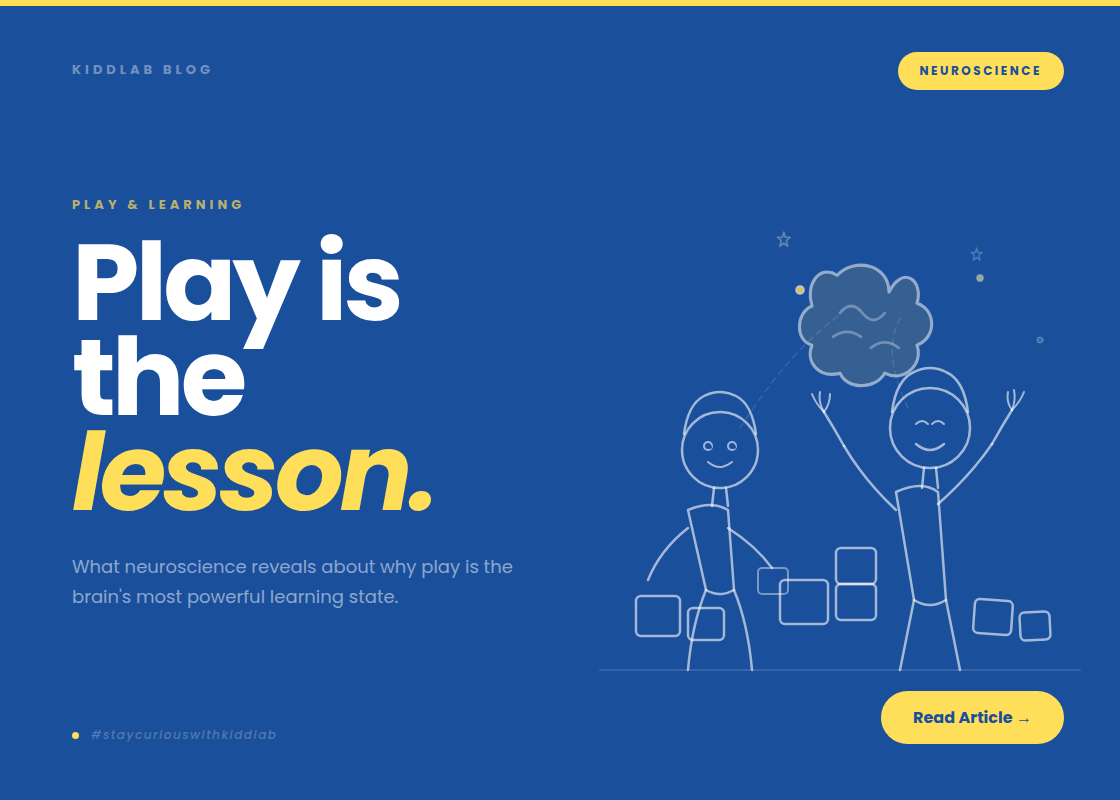
Most of us carry an unconscious hierarchy in our heads when it comes to children and learning. Structured instruction at the top. Play somewhere near the bottom — useful for letting off steam, for socialization, for the hours before the real work begins. It is a hierarchy that feels intuitive. It is also, according to decades of neuroscience, wrong.
Play is not what happens before learning. It is one of the most powerful mechanisms through which learning actually occurs.
What Happens in the Brain During Play
When children engage in open-ended, exploratory play — building something, testing an idea, acting out a scenario — the brain is not idling. It is doing some of its most productive work.
Research going back to Diamond et al. (1964) established a foundation that has only grown stronger over time: animals raised in stimulating, play-rich environments develop measurably thicker cerebral cortices than those in restricted conditions. More recent work by Barros et al. (2019) confirmed that social play specifically triggers neurogenesis — the birth of new brain cells — in the dentate gyrus of the hippocampus, the region most central to learning and memory formation. The brain, in other words, is not merely activated by play. It is physically shaped by it.
This matters because the hippocampus does not just store memories — it integrates new information into existing knowledge structures. When a child plays, they are not simply having fun. They are building the neural architecture that will determine how well they learn everything that comes after.
Play Is Not the Opposite of Rigour
One of the most persistent misconceptions about play-based learning is that it trades depth for enjoyment — that what children gain in engagement they lose in academic substance. The evidence does not support this.
Harding (2024) describes the moment when a young child's brain "jumps" and "lights up with joy" during immersive play, noting that the neural connections forming in that moment are not incidental to learning — they are learning. The play-driven neural pathways established before the age of six, she argues, have a lasting and compounding impact on future cognitive development. Diverting children away from their innate inclination to play does not accelerate learning. It removes the very conditions under which deep learning is most likely to happen.
This is reinforced by Bodrova, Leong, and Yudina (2023), whose work on play and self-regulation found that play-based interventions in early childhood settings produce measurable gains in cognitive control and executive function — outcomes that are notoriously difficult to achieve through direct instruction alone. Children who develop these capacities early carry them into every learning context they will ever encounter
What This Means in Practice
The practical implication is not that structure is bad or that all learning should be unguided. The research is clear that the most effective play-based environments are intentionally designed — with educators who observe, scaffold, and ask the right questions at the right moments.
What it does mean is that protecting time for play is not a concession to childhood. It is a pedagogical commitment. Every hour of joyful, hands-on, exploratory activity is an hour in which the brain is building connections, consolidating memory, and developing the self-regulatory capacities that predict long-term academic and life success.
Play is not a break from the curriculum. For a developing brain, it is the curriculum.
References
Barros, M., et al. (2019). Social play and neurogenesis in the hippocampus. Behavioural Brain Research. https://doi.org/10.1016/j.bbr.2018.11.004
Bodrova, E., Leong, D. J., & Yudina, E. (2023). Play and self-regulation: Lessons from Vygotsky. Frontiers in Psychology, 14, 1034633. https://doi.org/10.3389/fpsyg.2023.1034633
Diamond, M. C., Krech, D., & Rosenzweig, M. R. (1964). The effects of an enriched environment on the histology of the rat cerebral cortex. Journal of Comparative Neurology, 123(1), 111–120. https://doi.org/10.1002/cne.901230110
Harding, J. (2024). The brain that loves to play: A visual guide to child development, play, and brain growth. Routledge. https://doi.org/10.4324/9781003309758