3 ways to make learning actually stick
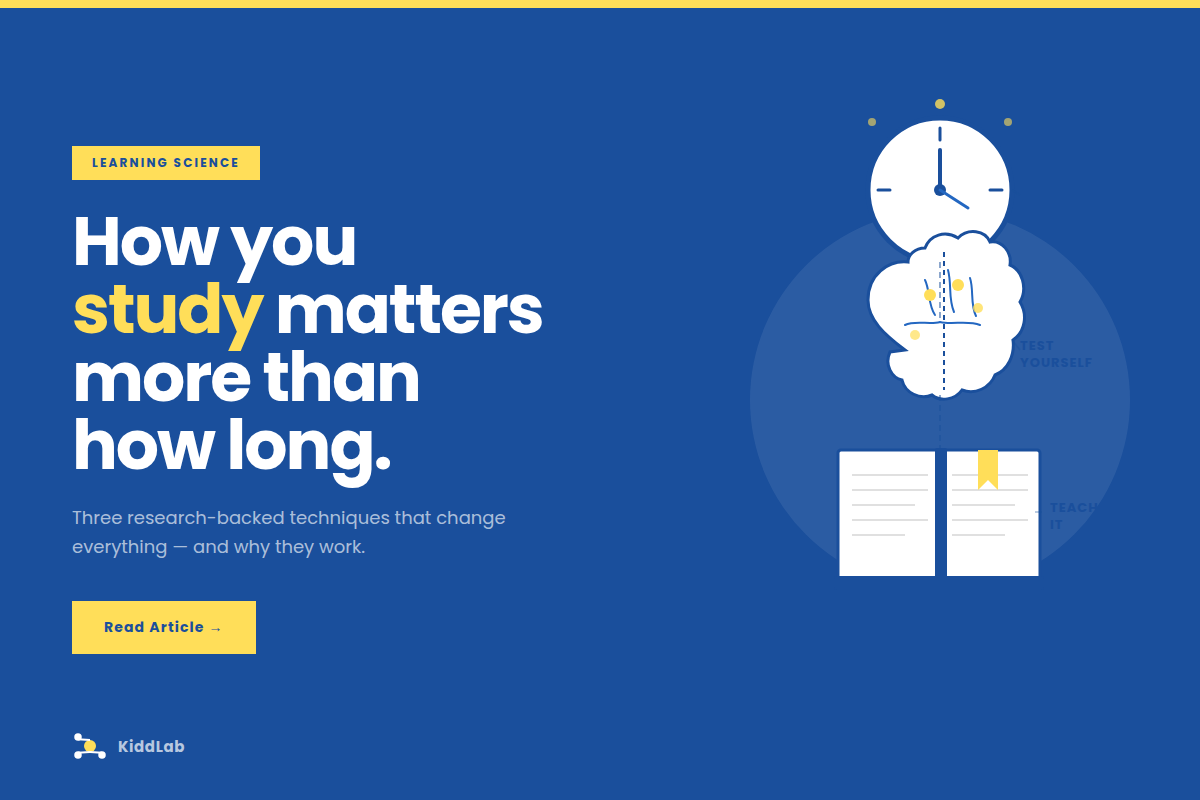
Most of us were never taught how to learn. We were taught what to learn — but the mechanics of how memory actually works, how knowledge moves from short-term to long-term, how practice shapes retention — that was left to chance.
The result is that most people default to strategies that feel productive but aren't: re-reading notes, highlighting passages, reviewing material the night before an exam. These methods are comfortable. They create a sense of familiarity. But familiarity is not the same as memory.
The science of learning has identified a small set of techniques that consistently outperform the rest. Three of them are particularly well-supported — and surprisingly simple to apply.
1. Spaced Repetition: The Timing of Review Changes Everything
The core principle is simple: reviewing the same material on multiple occasions, spread over time, produces dramatically better retention than reviewing it all at once. Each time you return to something you have partially forgotten, your brain doesn't just restore the memory — it consolidates it more deeply into long-term storage, slowing future decay.
This is not a new idea, but recent research continues to confirm its power across populations and contexts. A 2025 large-scale study of over 26,000 physicians found that spaced repetition significantly improved both knowledge retention and transfer compared to a control group — and the effects held even when questions were reviewed just once or twice at spaced intervals (Price et al., 2025). A 2024 randomized controlled trial with dental students found that learners using spaced repetition with mobile flashcards showed significantly higher retention at one and three months compared to peers using traditional lecture-based learning (Santhosh et al., 2024).
For parents and educators, the takeaway is practical: short, frequent review sessions beat long, infrequent ones. The goal is not to study more — it is to study at the right intervals.
2. Retrieval Practice: The Test Is the Learning
Re-reading feels productive. It is passive, comfortable, and creates a sense of fluency — the feeling that you know the material because it looks familiar. But recognition is not recall. And recall is what learning actually requires.
Retrieval practice — actively attempting to recall information rather than passively reviewing it — strengthens memory in a way that re-reading cannot. A comprehensive review published in Nature Reviews Psychology confirmed that both spacing and retrieval practice consistently produce superior learning outcomes across ages and subject areas, describing the evidence base as among the strongest in cognitive science (Carpenter, Pan, & Butler, 2022).
More recent work has added nuance: retrieval practice is especially effective when learners have sufficient working memory capacity to successfully complete the recall attempt — suggesting that breaking material into manageable chunks before testing yields better results than testing on overly complex material all at once (Zheng, Sun, & Liu, 2023).
Practically, this means closing the book and trying to recall what you just read. Writing down what you remember before checking. Using flashcards. Testing before you feel ready. The discomfort is not a sign that something is wrong — it is the signal that learning is happening.
3. The Protégé Effect: Teaching as the Deepest Form of Learning
There is a principle often attributed to Richard Feynman: if you cannot explain something simply, you do not understand it well enough. The research on what is now called the protégé effect confirms this intuition.
When people prepare to teach material — or actually teach it — they process it more deeply, organize it more coherently, and identify gaps in their understanding more readily. A 2025 review of the protégé effect across multiple educational contexts found that students who learned with the expectation of teaching consistently outperformed those studying for their own use, and that the benefit extended to long-term retention and application, not just immediate recall (Oginni et al., 2025). The effect appears to be driven by how teaching forces active organization of knowledge — you cannot present what you do not understand.
A child who explains a concept to a parent, a student who teaches a classmate, an adult who writes out what they have learned — all are engaging the same mechanism. The process of articulating knowledge exposes what is missing and strengthens what is solid.
Why These Three
Spaced repetition, retrieval practice, and the protégé effect share something important: they all require the learner to do cognitive work. They are not passive. They are not comfortable. And they are not the strategies most people default to.
But the discomfort is precisely the point. Memory is not a recording — it is a reconstruction. Every time we retrieve a memory, we are rebuilding it. The strategies that feel hardest are often the ones that build the most durable knowledge.
Understanding how learning works does not make it effortless. But it does make it more intentional — and over time, considerably more effective.
References
Carpenter, S. K., Pan, S. C., & Butler, A. C. (2022). The science of effective learning with spacing and retrieval practice. Nature Reviews Psychology, 1, 496–511. https://doi.org/10.1038/s44159-022-00089-1
Oginni, B. M., Malik, K. P., & Folorunsho, E. B. (2025). The protégé effect: How teaching expectancy and interactivity influence learning and retention. Journal of Teaching and Learning, 19(1), 107–130.
Price, D. W., Wang, T., O'Neill, T. R., Morgan, Z. J., Chodavarapu, P., Bazemore, A., Peterson, L. E., & Newton, W. P. (2025). Effect of spaced repetition on learning and knowledge transfer in a large cohort of practicing physicians. Academic Medicine, 100(1), 94–102. https://doi.org/10.1097/ACM.0000000000005856
Santhosh, S., et al. (2024). Effectiveness of spaced repetition learning using a mobile flashcard application among dental students: A randomized controlled trial. Journal of Dental Education, 88(9), 1267–1276. https://doi.org/10.1002/jdd.13561
Zheng, Y., Sun, P., & Liu, X. L. (2023). Retrieval practice is costly and is beneficial only when working memory capacity is abundant. npj Science of Learning, 8, 8. https://doi.org/10.1038/s41539-023-00159-w